Saturday, 12 December 2009

Monkeys with Typewriters


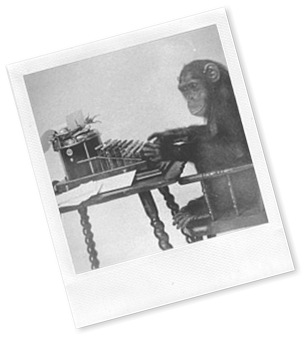
Monkey-typing   On Wednesday, I attended the book launch of Jemima Gibbons’ new book on social media, Monkeys with Typewriters.

The book is named after the theoretical monkeys or apes who, given long enough, produce the complete works of Shakespeare, and therefore explain the golden rules of social media:

  1. It’s simple (because monkeys can do it)
  2. It’s fun (why else would monkeys bother)
  3. Its ubiquitous (everywhere you look, there’s another goddamn monkey with a typewriter).


The book is one of the best I’ve read on social media - partly because a lot of Jemima’s experiences resonate for me (I’m one of the people who have never quite managed to get to Tuttle, but I have been a Fellow of the RSA for most of the last 15 years) – but there are other reasons too.

The book is written as a narrative, describing a series of experiences which I think works well.  And it also provides a lot of information, a lot of which is surprisingly current, and quite a bit of which is new for me – and I read a lot about this space.  All the book’s arguments are also very well referenced and supported.

But I’m also impressed because I think the book outlines the the paradigms that come with working with social media very well.

I’m particularly pleased to find that Jemima agrees with my own perspective that we need to focus on people, and what the technology enables people to do, rather than starting from the technology itself.

So, much of the book focuses on the required changes in leadership within a social media enabled environment, ie one that is not about:

  • command and control
  • micro-managing
  • over-structuring.


But instead, is based upon:

  • co-creation
  • passion
  • learning
  • openness
  • listening
  • generosity.


Jemima describes her dream environment as one which looks like the world-wide web (or at least, web 2.0 – Gary Hamel’s argument too):

“Wouldn’t it be great to have a system where people worked together constructively without the need for micro-management?  Where people were passionate about what they did?  Where there was a common understanding of objectives and protocols?  Where people knew who to ask if they wanted advice or where to go if they needed feedback on something?  Where there were numerous experts on hand to give advice for free?  Where people co-operated and shared stuff without arguing, and got rewarded for doing so?  Where people were valued and appreciated by their peers?  An overwhelmingly create environment, where ideas and materials were frequently re-used, re-purposed and mashed together in order to form new, eminently desirable products and services – desirable because it was the consumers themselves who had shaped them?”


I still think we need to take Jemima’s argument regarding people vs technology further however. For me, we need to be much clearer about what we’re trying to create.   Focusing on an environment which is enabled by social technology is still inherently about technology.  We need to go beyond this and think about all the different ways the desired environment can be created.

Even better we can go beyond talking about environment and focus on the outcomes this environment provides us, whether this is customer or employee engagement, knowledge, productivity or connections and relationships – or social capital (which is, in my view, the key outcome from both social technologies and the environment that Jemima describes).

Once we’re clear about the outcomes, we can look at which environments and which technologies or other enablers can best create these. My belief is that this can lead to an even more compelling case for change than the arguments Jemima uses for her very human organisational environment.

But I do think this book is a big step forward (from Andrew McAfee’s ‘not not about the technology’ for instance).


Picture credit: Chris 73


  • Consulting  - Research - Speaking  -  Training -  Writing
  • Strategy   -  Team development  -  Web 2.0  -  Change
  • Contact  me to  create  more  value  for  your  business
  • jon [dot] ingham [at] social [dash] advantage [dot] com

.

Friday, 4 December 2009

CIPD09: A New Leadership Paradigm (Part 3)


ASDA Leadership  I’ve already posted twice on the last keynote session from this year’s CIPD conference, ‘A New Leadership Paradigm’ (part 1 - the preview and part 2 – the live blog).  I’d now like to summarise my take-aways from this and other sessions at the conference.

First of all, I thought the keynote debate was really well done.  All three speakers clearly had different perspectives, with Sir Christopher Kelly providing a rather more traditional view of leadership to the others.  However, it was still useful to have him included, as I think things are going to take longer to change in the public sector, and his views helped to keep discussion rooted in reality.

And it is also possible to link all three speakers’ perspectives together.  In his presentation with Julie Smith from PepsiCo, Jasvier Bajer explained that the true definition of leadership is ‘the ability to create movement and deliver change’.  And I think all speakers would agree with this.

But I don’t think Kelly’s views expressed the new paradigm (which is probably why he didn’t think there is one).  The future of leadership isn’t just more management; and its not about command and control.  As David Smith stated in his presentation of ASDA’s change story (see slide), tell & do autocracy is already dead.

The paradigm shift, like the broader shift in the organisational people management agenda is about transparency, authenticity and sustainability.  It’s why I like Avolioand Gardner’s description of authentic leaders (provided by Jane Turner, Newcastle Business School in her workshop on internal coaching):

“Those who are deeply aware of how they think and behave -and are perceived by others as being aware of their own and other’s values, knowledge and strengths; confident, hopeful, optimistic, resilient and of high moral character”


This definition really is, I think, at the heart of the new paradigm of leadership.  

  • Transparency – an alignment between real and perceived
  • Authenticity – based on self-awareness
  • Sustainability -confident, hopeful, optimistic, resilient


But I also think there’s one more piece in this – and this is connectivity which I’ve also already posted on as my additional key message from the conference.

In terms of leadership, this area was best addressed at the conference by Emmanuel Gobillot’s presentation of Leadershift:

“To stay relevant leaders will need to move towards Leadership 2.0 – a type of leadership, non-hierarchical in form, that facilitates the collaboration of a self-selected group.  In this new context, the leader is an integral part in the generation of a narrative that builds and sustains this group’s valuable and co-created outcomes.”


In reflecting back on the conference, I’ve been also be drawn to Gautam Ghosh’s recent post on leadership in hyper-linked times.  In his view, the behaviours of leaders must reflect the new tenets of OD:

  1. Openness and Transparency
  2. Conversation (MBWA)`
  3. Content (co-creation of the brand)
  4. Collaboration
  5. Communities (shared interest groups or tribes connecting around various 'social objects’)
  6. Collective Intelligence

Gautam also notes that these behaviours aren’t new.  But put them all together – transparency, authenticity, sustainability and connectivity – and I think you do arrive at something like a new paradigm for leadership.  And although I’ve mainly be posting here on the business use of web 2.0 tools, this new leadership paradigm is a important and integral aspect of gaining Social Advantage too.


  • Consulting  - Research - Speaking  -  Training -  Writing
  • Strategy   -  Team development  -  Web 2.0  -  Change
  • Contact  me to  create  more  value  for  your  business
  • jon [dot] ingham [at] social [dash] advantage [dot] com

.

Tuesday, 1 December 2009

Looking back to December 2008


   You may also be interested in these posts from the end of last year:
 

Or even the year before?


My contact details:

  • Consulting  - Research - Speaking  -  Training -  Writing
  • Strategy   -  Team development  -  Web 2.0  -  Change
  • Contact  me to  create  more  value  for  your  business
  • jon [dot] ingham [at] social [dash] advantage [dot] com

.

Picture credit: Matthew Jordan

Tuesday, 24 November 2009

More from the CIPD conference – developing a culture of…


Lousy T shirt   There were quite a few sessions at the conference about developing a culture of something, eg of:

  • Coaching (Jane Turner, Newcastle Business School)
  • High performance (David Smith, ex-ASDA)
  • Homogeneity in a global context (Mark Adams, Abbey / Santander)
  • Innovation (Jaideep Prabhu, University of Cambridge)
  • Integrity (Roger Steare, Cass Business School)
  • Leadership (Anete Jajkowska, Microsoft)
  • Resilience (Rebecca McIntosh and Claire Jelley, also at the University of Cambridge, but internal this time).


However, there wasn’t any linking between sessions these even thought the actions organisations need to take to develop each one of these cultures are largely the same thing!

Basically, there are two or three key steps:


1.    Decide what / how you want to be

Organisations can’t do everything, so the key question is which of the capabilities from the above list are most important for you?  Having a clear BHAG or mojo will make this easier for you.

Describe the required capability in detail – what behaviours and actions will you expect to see when this capability is in place?  This becomes what McIntosh and Jelley referred to as their North Star.

This is, of course, where things between each of the culture types are a bit different, and where some knowledge of the particular type of culture, and what attributes / behaviours support it, is required.

For a culture of innovation for example, Jaideep Prabhu suggests that organisations need three particular attitudes:

  • Future market focus
  • Willingness to cannibalise
  • Tolerance for risk.


Once these three things are in place, innovation should follow.

Actually, I think there’s probably a bit more too it than this ( read my post on Hal Gregersen’s presentation, and listen to the last Talking HR show where I discussed developing innovative cultures with MOK from the Innovation Beehive).


2.   Decide on the actions which are going to lead to the required attitudes (and them do them)

For innovation, Prabhu suggests the following:

  • Product champions
  • Asymmetric incentives
  • Internal markets.


Once again, I think it’s a little more complicated that this!  In fact, it’s the actions Prabhu doesn’t mention, that are common to the development of all these different types of culture that are the most important.

So, what are these?


Hard issues

Well, there are a few ‘hard’ issues, such as getting your ducks in a row, ie linking all of your HR and management activities to the required capability, and then monitoring these activities (see Microsoft’s system model, and people scorecard):


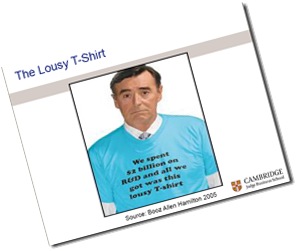
You might even want to produce a few T-shirts?


Soft issues

But the soft areas are the harder ones (if you see what I mean).

David Smith did a good job of describing some of these in connection with ASDA’s journey:

  • Hire for attitude
  • Communicate, communicate, communicate
  • Listening
  • Engaging style of management and leadership
  • Remove your underperfomers, push your talent
  • Recognition
  • Fun / buzz and a sense of community.


But I think Roger Steare captured what’s at the heart of changing these soft issues even more accurately.  For him, good behaviour and culture is when:

  • People stop and think
  • People talk about shared values
  • People unite around a common purpose
  • People act fairly for the common good.


Out of these, it’s talking (- particularly about what’s important - see Emmanuel Gobillot’s ‘narratives’) which is at the hear of culture change.  There was a good post on this in Harvard Business / Peter Bregman’s blog How We Work, this Summer.  This put culture change down to the way we tell stories:

"You change a culture with stories. Right now your stories are about how hard you work people. Like the woman you forced to work on her wedding day. You may not be proud of it, but it's the story you tell. That story conveys your culture simply and reliably. And I'm certain you're not the only one who tells it. You can be sure the bride tells it. And all her friends. If you want to change the culture, you have to change the stories.


I told him not to change the performance review system, the rewards packages, the training programs. Don't change anything. Not yet anyway. For now, just change the stories. For a while there will be a disconnect between the new stories and the entrenched systems promoting the old culture. And that disconnect will create tension. Tension that can be harnessed to create mechanisms to support the new stories.”


It emphasises, I think, that much of what we mean when we talk about culture change is actually social capital (which I define as the value of the connections, relationships and conversations taking place between people in an organisation).

And which brings us straight back to the importance of Connectivity again!


Cross posted from Strategic HCM.


  • Consulting  - Research - Speaking  -  Training -  Writing
  • Strategy   -  Team development  -  Web 2.0  -  Change
  • Contact  me to  create  more  value  for  your  business
  • jon [dot] ingham [at] social [dash] advantage [dot] com

    .

Sunday, 22 November 2009

CIPD conference summary: Connectivity


   Jackie Orme didn’t include this as a theme, but it was certainly one for me.  And I think it builds upon the previous three: transparency, authenticity and sustainability.  And behind this is the fact that we live in a social world – and this came through strongly too:

  • In ‘Leadershift’, Emmanuel Gobillot suggested that leadership needs to be connected
  • In ‘The Future of Work and Organisations’, Richard Worsley from the Tomorrow Project noted that knowledge is a social activity
  • In ‘Harnessing the Power of Social Media’, Nick Shackleton-Jones explained that learning is largely social too (that information comes with emotional tags)
  • And in ‘Coaching to build Innovative Mindsets’, Nick Jankel from wecreate positioned social collaboration as a basis for innovation.


Social connecting also came up in presentations from:

  • Callum Petrie from Philips Electronics, where connecting with employees is seen as a basis for performance (see slide)
  • Kathryn Pritchard and Judy Noonan from iris, for similar reasons
  • Jacky Simmons from TUI, where interrelating is positioned as the centrepiece of an approach to developing organisational resilience.  Interrelating consists of:
    • Connecting across the organisation through the development of strong networks
    • Collaborating by developing shared plans, cooperating and sharing knowledge.


But probably the most powerful argument for improving connectivity was provided by Andrew Kakabadse from Cranfield in his presentation on the divisions between members of top teams.

Kakabadse’s research suggests that banks knew about the credit problems 15 months before the financial meltdown, but that division, denial and paralysis had become the cultural norm.  More broadly, he suggests that Boards often share few penetrating insights and have little shared view of differentiation and competitive advantage.

If this is the case, how likely will it be that employees will all share one common view?


So what can organisations do to develop greater connectivity and improve collaboration?  I’ve already posted on the role of social media, but there are many other opportunities too.  In his session on organisation design, Andrew Campbell from Ashridge suggested that organisations need to guard against these blockages on collaboration:

  • Unclear objectives
  • Differing objectives or incentives
  • Competition for money, people, promotion, praise
  • Unclear authorities
  • Transfer prices
  • Physical or cultural distances
  • Interfering bosses
  • Control freeks or secrecy.


And in her workshop on ‘Facilitating OD Interventions’, Sylvia Baumgartner suggested that we need to influence group dynamics, particularly as work becomes increasingly situational and less routine.  Appropriate OD interventions include:

  • Diagnostic activities
  • Team-building activities
  • Survey feedback activities
  • Education and training activities
  • Structuring activities
  • Process Consultation activities
  • Third-party mediation activities
  • Competency development
  • Coaching and counselling
  • Life and Career Planning activities
  • Planning and Goal Setting activities
  • Strategic Management activities
  • Organisational Transformation activities
  • Organisational Effectiveness
  • TQM (Total Quality Management)
  • Conversations…..


All of the above issues and activities are things that I deal with on this and my other blog, Strategic HCM.

It’s why I was rather critical of the session on Next Generation HR.  The rise of connectivity is leading to much bigger changes that those identified there.

These include the social business (enabling organisations to connect with their people) and social HR  / HR 2.0 (the move to facilitating rather than managing HR outcomes).

And it’s also why I was delighted with Shaa Wasmund’s description of me in her tweet:

Shaa Wasmund tweet


(This post is cross posted from Strategic HCM.)


  • Consulting  - Research - Speaking  -  Training -  Writing
  • Strategy   -  Team development  -  Web 2.0  -  Change
  • Contact  me to  create  more  value  for  your  business
  • jon [dot] ingham [at] social [dash] advantage [dot] com

.

Thursday, 19 November 2009

CIPD09: A New Leadership Paradigm (Part 2)


   Live blog from the CIPD 2009 conference final panel keynote:


And it’s a wrap!


This post has been cross-posted from Strategic HCM.  Also Also see part 1 of this post there.


  • Consulting  - Research - Speaking  -  Training -  Writing
  • Strategy   -  Team development  -  Web 2.0  -  Change
  • Contact  me to  create  more  value  for  your  business
  • jon [dot] ingham [at] social [dash] advantage [dot] com

.

CIPD09: A New Leadership Paradigm


   I enjoyed day 2 of the CIPD Conference more than day 1 (I met some people who thought the reverse, so of course it’s a personal thing, partly depending upon which sessions you attend, and a whole heap of other things as well).  I particularly enjoyed Nick Baylis on ‘the Rough Guide to Happiness’ and Sarah Redshaw from Unilever on ‘Building Transformation through Engagement’.  I’ve not blogged on these sessions, but you can see plenty of tweets from me and others on Twitter, using the hashtag #CIPD09 (if you don’t know what this means, you really should you know).

The highlight from today should be the end of day keynote, ‘a New Leadership Paradigm’.  The outline certainly looks interesting (and just seeing John Humphrys live should be good):


Public respect for leaders has hit an all time low. The exposed inadequacy of those in leadership positions has brought current thinking on leadership and the established models into question.

Today, it seems that there is a substantial lack of ‘real’ and successful leaders equipped with both the resilience and capability to deal with the complexity and pressures of the ever changing global market. So are we now at a cross roads? Is this an ideal opportunity to challenge the current view of what it takes to be a good leader and to establish what behaviours and competences will be needed to lead organisations and societies into our uncertain future?


Join us to debate:

  • Why and how have traditional models failed?
  • How can we learn from the past and build on its successes?
  • How can we re-establish leadership credibility?
  • What skills and attributes will successful leaders of the future need?


I’ll be live blogging from the session, but here are a few thoughts to warm-things up.

Firstly, I think it is a really big and important question.  I do think existing leadership is failing.  Look at Hay’s stats from yesterday, or simply the end results (the recession we’re now in).  And we know that leadership accounts for a significant part of this (Jim Collins’ point that leaders can destroy organisations on their own).

I agree that resilience and capability are part of what needs to be fixed.  But I think attitudes need changing too.  We need to look again at what we mean by leadership and change the way that leaders lead.

And we’ve had a few pointers during the conference, particularly from Jim Collins on Level 5 leadership, and the need for leaders to act through others to create greatness; and Emmanuel Gobillot on the connected leader in his session on Leadershift.

Leaders may have a particular role but they achieve success through their community.

It seems to be a view that’s taking off.

I was talking about this with Jonathan Austin at the Best Companies exhibition stand yesterday too.  He had just attended a session with Edgar Schein where Schein had been talking about leaders as ‘humble engineers’ who need to work through others to make their organisations work.  And I’ve already posted on Social Advantage on Henry Mintzberg’s concept of Communityship.

Emphasising that companies are not collectives of human resources, but communities of human beings, Mintzberg suggests that traditional views of leadership isolate people in leadership positions, thereby undermining a sense of community in organisations.  He believes leadership and communityship go hand-in-hand: "A community leader is personally engaged in order to engage others, so that anyone and everyone can exercise initiative".

And it’s by developing this sense of community that individuals become bound to each other and start to want to focus on developing the productivity of their organisation as a whole, rather than acting purely out of self-interest.


That’d be the basis of my answer if I was on the stage today.  And it’s also one of the things I write about at my other blog, Social Advantage, and you might want to check over there.

Join me for the live blog if you can!


This post is cross posted from Strategic HCM.


  • Consulting  - Research - Speaking  -  Training -  Writing
  • Strategy   -  Team development  -  Web 2.0  -  Change
  • Contact  me to  create  more  value  for  your  business
  • jon [dot] ingham [at] social [dash] advantage [dot] com

.

Wednesday, 18 November 2009

Using social media at CIPD09


My favourite session yesterday was Nick Shackleton-Jones (@shackletonjones) on the use of social media supporting online learning at the BBC.  I was going to blog on this, but Rob Moss from Personnel Today got their first, so see his summary on this.

Instead, I thought I’d write about the use of social media at the CIPD conference itself.

There have been quite a few of us blogging and tweeting, and in many ways, this has led to the development of a small community, sharing experiences and learning with everyone else through social media, but also face-to-face between ourselves.   At times, it’s felt like a conference within a conference.

So, thanks for a great conference everybody!

Martin Couzins (@martincouzins) and Rob Moss (@robmoss) plus Kat Baker and Louisa Peacock from Personnel Today / XpertHR (@PersonnelToday  / @XpertHR / @HRSpace), all busy in the Press Office:

DSCN1858 

DSCN1860

Charlie Duff (@charlie_elise) from HR Zone (@HRZone) :

DSCN1842

Adrienne Fox (@foxlondon)writing for HR Magazine (US):

DSCN1876

Jennifer Liston-Smith (@listonsmith) writing for the BPS:

DSCN1856 

Mike Morrison from RapidBI (@rapidbi) on the right, also with Nick Spindler from Nationwide:

(Check our Mike’s notes from the conference at cipd2008.blogspot.com)

DSCN1835

Steve Bridger (@stevebridger) from CIPD Communities (@CIPDcommunities):

DSCN1855


Last night, we met up at the CIPD’s tweet-up.

Julia (Twitter username pending!):

DSCN1866

Mike (@rapidbi) with Klothilde (@kganzer):

DSCN1868

Steve and David (sharing @RightwayCWS) with Irsa (username pending)

DSCN1869 

The CIPD’s Natalia (@NAlexandrou or @CIPD_Events) with Charlie (@charlie_elise or @HRZone) and Steve (@stevebridger or @CIPDcommunities):

DSCN1863


Well done to the CIPD for raising the role of social media this year.  There’s still a way to go, but it’s been a very good start.


A few other non-Twitter peeps (I won’t say ‘muggles’ again!).

Perry Timms from the BIG Lottery Fund before his session ‘Communicating with Impact’:

DSCN1831

Former colleague, Alison Crossley:

DSCN1851

The Elsevier stand – my book’s just about visible on the back shelf:

DSCN1832


Cross-posted from my Strategic HCM blog.


  • Consulting  - Research - Speaking  -  Training -  Writing
  • Strategy   -  Team development  -  Web 2.0  -  Change
  • Contact  me to  create  more  value  for  your  business
  • jon [dot] ingham [at] social [dash] advantage [dot] com

.

Monday, 16 November 2009

HR & social media workshops


HR Society logo   I’m doing quite a few workshops on HR’s use of social media over the next few months.

One session I’ve just agreed on is going to be with the HR Society (not till March though).

I’m going to be looking at the 3 parts of the agenda I believe are important:

  • The Social business – what this is, and why it’s a great opportunity for HR
  • Social HR – how HR can use social media tools to support recruitment, learning etc.
  • Social media practice – an experiential session ensuring all participants have some personal understanding of how they might use the tools themselves.


If you’re a member, do ensure you’ll come along, and if not join! – or ask me to do a session just for you and your organisation etc.


  • Consulting  - Research - Speaking  -  Training -  Writing
  • Strategy   -  Team development  -  Web 2.0  -  Change
  • Contact  me to  create  more  value  for  your  business
  • jon [dot] ingham [at] social [dash] advantage [dot] com

.

Monday, 9 November 2009

Enterprise 2.0 conference: Connecting the Dots


   In his comment to my last but one post, reviewing Andrew McAfee’s book and his presentation at the Enterprise 2.0 conference in San Francisco, Mike Ricard, Enterprise 2.0 Community Manager at Reed Elsevier responds to my view that Enterprise 2.0 needs to be much broader than IT by stating:

“Those tools are social enablers. The alternative I have seen HR suggest are people networking 'get togethers'. That's OK if you are in the same country and you can manage to coordinate your schedules, but what if you are not and you can't? And often it is the same A-types who dominate the proceedings.”


I have responded that:

“I don't mean to trash web 2.0. I agree it an absolutely key social enabler. But I think there are more... and that HR can do much more than organise get-togethers too.”


I hope to take this argument to the next Enterprise 2.0 conference in Boston next Summer.  I’ve submitted my proposal (the first one on the site) and you’ll have the opportunity to vote for it from early next year.

Here’s the text:


Connecting the Dots to Competitive Advantage

Session Description

Enterprise 2.0 can increase efficiencies and help meet business objectives but it can also generate competitive advantage. To create higher levels of value, the use of social technologies needs to be linked to other organizational enablers, eg HR practices, OD interventions, facilities design etc. This session will show how.


Professional Biography

Jon Ingham consults with organizations to help them develop human and social capital as a key source of competitive advantage.

He generally works with employers that already have sound management approaches and helps them extend their agendas to gain further improvements in the capabilities and engagement of their people, and the effectiveness of their organizations. He is based in the UK but works on a global basis.

Jon also works as a researcher, speaker, trainer and writer. He has recently spoken in the US, Europe,Africa, the Middle East and Asia. He has also lectured in strategic management, change management and human resources on executive MBA courses in both West and East Europe.

Jon started his career in Engineering, then spent six years working in IT before moving into Change Management where he has spent most of his career. He has also worked internationally as an HR Director.

Jon has a BA in Psychology, a Masters in Engineering and an MBA. He is a Certified Management Consultant, a member of the British Psychological Society (BPS) and its occupational psychology division, a Fellow of the Chartered Institute of Personnel and Development (CIPD) and a Fellow of the Royal Society of Arts (RSA).


Company Background

Strategic Dynamics Consultancy Services Ltd is a human capital and change management consultancy with a difference. What makes us unique are our beliefs that:

  • People are a key source of innovation and competitive advantage - we use this insight to help transform people and organisational capability
  • People are the focus of effective change – we work with, not against, the quirks of human spirit and the dynamics of human behaviour
  • People work best in open, challenging, collaborative relationships – our consultancy services are based on this approach.


The consultancy is led by Jon Ingham, an experienced business manager and consultant, and is supported by a small team of employed and associate consultants.


  • Consulting  - Research - Speaking  -  Training -  Writing
  • Strategy   -  Team development  -  Web 2.0  -  Change
  • Contact  me to  create  more  value  for  your  business
  • jon [dot] ingham [at] social [dash] advantage [dot] com

.