Thursday, 17 November 2011

With Demos on social mobility


   This blog tends to deal with organisational social collaboration, and within this agenda, its main focus is often on social technologies.  That’s not actually my intent –I do want to focus more broadly on other aspects of being social in organisations eg social responsibility outside these organisations, as I do believe these issues all inter-relate, or at least require a similar perspective. 

Well yesterday morning I attended a roundtable on social mobility with political think tank, Demos.  With a few HRDs, journalists, researchers and parliamentary special advisors there, we had what I thought was a good discussion about this issue, a couple of points from which I summarise below:

  • The concern is over relative social mobility (ensuring the low-skilled / paid can progress upwards – as well as the high skilled / paid downwards) rather than absolute mobility (increasing the standards of living for everyone).  [And people talk about HR-speak!  Unless I’m missing something, I interpret this as concern for social mobility over what you get at the bottom of society if there isn’t any mobility.]
  • The government is struggling with challenges relating the open vs the big society (from an open society perspective, the big society’s focus on informal social networks is one of the main problems in society).
  • Some organisations invest in supporting social mobility (apprentice programmes, paid interns, work experience programmes etc) for philanthropic reasons, some because they think there is a business case – even if it sounds to everyone else as if they’re just doing it because they think it’s the right thing to do.  Most don’t do very much at all.
  • Individuals with ‘low social mobility’ ie crap jobs need to raise their aspirations – neither the government nor employing organisations can do this for them.


I didn’t get a chance to add to the debate yesterday, but the points I would have made are:

  • There isn’t a solid enough business case to invest in social mobility at the moment, particularly when many of them are just trying to stay in business.  I agree that talent management professionals should have a longer-term focus but I don’t think this is the right time to ask.
  • Having said that, there are some signs that focus in areas like social responsibility in increasing, and the government should obviously push the door when there’s an opportunity of it opening.  Organisations can sign up for the government’s social mobility contact here.  The most impactful thing I think organisations could do however, would be to start giving better feedback to job seekers, particularly those who have just left school or university, or are from disadvantaged backgrounds etc.
  • But what’s really needed, I think, is for organisations to change the way they work, and be smarter in what they do - and doing this, might well provide a business case. One thing that would help would be switch in focus from always recruiting the best people to recruiting the most cost effective, eg someone from a lower status university who might not be quite as good (though there did seem to be fairly broad support at the roundtable is that what differentiates the high status Russell Group universities from the rest is the attendance of confident if incapable ‘Dim Tim’s).  But because there’s less competition for theses less attractive individuals they can be picked up without paying anything like so much (a bit like John Boudreau’s arguments for focusing on pivotal talent management perhaps).
  • As another example, one of the speakers talked about PwC moving from recruiting graduates to school leavers.  Well I did this 15 years ago at Ernst & Young.  But the reason that we developed our Accounting Technician stream wasn’t about a philanthropic concern or even a business case for social mobility, it was because we’d redesigned the organisation and realised that not everything done by an auditor needed a chartered accountancy qualification.  So when Demos ask ‘how cna the government up-skill HR professionals to implement more effective social mobility strategies in the workplace’, I have to say 1, that they can’t, and 2, that it’s the wrong question anyway.  HR, and other business leaders, just need to be smarter at building their organisations differently (ie better).  If they did this, then work wouldn’t be so hour glass (or even squeezed toothpaste tube shaped.
  • I’d also like to see organisations loosing some of their focus on individual talent management and putting a bit more effort into building collaborative organisations (ah, back to that again!).  I think social mobility, and just generally better performance, would be a natural consequence of this sort of shift as well. 


Picture credit: accent on eclectic


  • Consulting - Research - Speaking - Training - Writing
  • Strategy - Team development - Web 2.0 - Change
  • Contact me to create more value for your business
  • jon [dot] ingham [at] social [dash] advantage [dot] com

.

Saturday, 5 November 2011

Chairing the Social Workplace conference


   On Tuesday I chaired the new Social Workplace conference in London.

This was a great event, focused on the digital workplace.

Highlights for me were:

  • Lee Bryant’s points about:
    • Social business will be key to engineering ourselves out of the economic crisis
    • It fits exception handling in a complex process driven organisation
    • Humans being leaky so organisations will never have 100% data security
    • Amazon having ‘2 pizza teams’ (if two pizzas is not enough to feed it then the team is too big)
  • Benjamin Ellis talking about:
    • Digital being about engagement – making someone want to come and play on a website vs traditional interrpution marketing (putting the intranet on the home page – similar to putting adverts in the middle of a TV programme) eg a good strategy is to tell people NOT to use the intranet
    • The spectrum of communication activities ranging through broadcasting to feedback (still over a closed channel) to dialogue to networking
    • The culture of sharing which works best if you share something when it’s unfinished
    • Measurement being largely qualitative – through tags and comments
  • Elizabeth Lupfer on social experience and the importance of employee profiles, tagging and social recognition (gamification):


Picture credit: Olga Pavlovsky


Also see:


  • Consulting - Research - Speaking - Training - Writing
  • Strategy - Team development - Web 2.0 - Change
  • Contact me to create more value for your business
  • jon [dot] ingham [at] social [dash] advantage [dot] com

.

In the IBM Forum: conversations on social business


   After a week focusing on the ‘analogue’ / physical workplace, it was back into the digital world this week.  It was also a week on my feet as on Tuesday I chaired the Social Workplace conference in London and then on Wednesday and Thursday I chaired the new HR Technology (including social technology) conference in Amsterdam.  And it was a week of learning about IBM as I was with Jon Mell (who I interviewed recently) at the Social Workplace conference and Ian Bird at the HR Technology one.

But this focus actually started on Monday with a session at IBM featuring a few bloggers: Johnnie Moore, Peter Gold and Matt Alder (pictured) plus Mike Morrison (sat behind me) and some people from IBM, including Jon (pictured), and Stuart McRae, who I saw present on IBM’s jams earlier this Summer.

We kicked off with a suggestion from Jon Mell that in today’s organisation, where hierarchy doesn’t matter (doesn’t it?), being social is a key requirement, and that this needs to go beyond being digital.  For some reason, despite this encouragement to go broader, our conversation seemed to focus heavily on social tools.

Some of the key points we discussed, for me, were:

  • Our workforces are increasingly ahead of their organisations.
  • Despite this, social networking tools often aren’t working well in organisations – following your boss feel like friending your dad – not cool.
  • Where it works, it’s because social networking has been made an organic part of the business vs employees being social and then going back to work [though I challenged this as I think in the best social organisations, social plays a much bigger role than this].
  • There are some challenges in this too.  Stuart gave the example of auditors using the network of people they studies for their accountancy qualifications with in preference to senior staff in their own firms – leading to information leakage and greater difficulty in firms establishing their own approach.
  • People naturally follow social processes rather than business processes, so we need to unforce people (from using business processes) rather than force them (to use social processes).
  • Unplanned outcomes are often the most interesting.    Peter gave an example of a retail company where staff pushed back against being given T-shirts.  When consulted they suggested shirts with logos of their products and turned a cost into a profit item.  This could never have been planned.
  • This is the difficulty with traditional business cases.  ROI can be a red herring.  IBM rewarded people for providing case studies.  This helped adoption and helped provide benefits for continuing work after starting it.


We also talked quite a bit about IBM’s own (Lotus) Connections product – including a rather bizarre (to me) conversation comparing Connections to BuddyPress (just because I think this has precisely no connection to the social business), though we got into IBM’s own use of Connections more deeply at the Social Workplace conference.


So an interesting debate, though the most interesting part of the day for me was walking back to the tube with one of the other bloggers, (perhaps because this is where we got more social?). We both agreed that the session had suffered from a couple of limitations:

  • A lot of what makes social works is doing the right thing in a particular organisation. It depends on this – on what leaders or other individuals do – not what we as thought leaders think they should be doing!
  • We weren’t totally sure how much IBM has taken ownership of the event, or whether this is just a good idea of their PR agency.  And Jon, it really isn’t very social to disappear from your own session!


Anyway, you can keep track of IBM’s work on the social business at http://www.facebook.com/IBMSocialBusiness.

Also see Peter Gold’s report on the session.


  • Consulting  - Research - Speaking  -  Training -  Writing
  • Strategy   -  Team development  -  Web 2.0  -  Change
  • Contact  me to  create  more  value  for  your  business
  • jon [dot] ingham [at] social [dash] advantage [dot] com

.

Wednesday, 26 October 2011

#SWConf interview with Jon Mell, IBM


And I think this will be my last interview, as it’s not much time till the conference.  This is with John Mell, Social Collaboration Leader at IBM North Europe.  Jon once again focuses on the importance of culture, and talks about the benefits of investing in the social workplace for customer service, R&D and HR.


  • Consulting - Research - Speaking - Training - Writing
  • Strategy - Team development - Web 2.0 - Change
  • Contact me to create more value for your business
  • jon [dot] ingham [at] social [dash] advantage [dot] com

.

Tuesday, 25 October 2011

#SWConf interview with Jenni Marshall on Social Communication


My latest interview is with Jenni Wheller, Internal Communication Manager at SSP UK.  Jenni describes the role of social in an organisation that 1. doesn’t have an existing internal communication function , and 2. in which 80% of their people work offline – a couple of challenges which might leave you thinking if social communication works there, where wouldn’t it work? (even if you don’t call it social media).

You can see more from Jenni at the Social Workplace conference on 1st November in London.


  • Consulting - Research - Speaking - Training - Writing
  • Strategy - Team development - Web 2.0 - Change
  • Contact me to create more value for your business
  • jon [dot] ingham [at] social [dash] advantage [dot] com

.

Thursday, 20 October 2011

Workplace Trends


   I spent most of yesterday at Workplace Trends: Property is a People Business.  The conference opened with a reinforcement of the opportunities that the workplace provides for generating performance through people and a regret that this isn’t yet understood more widely, eg with the conference chair’s proposal to the CIPD annual conference being rejected (workplace design was also a theme in my own broader proposal which was also rejected).

The main theme of the conference seemed to me to be about how our office buildings enable people to be effective.  For example there was a panel session mid-day debating whether property is a people business - which not unexpectedly was supported, though we also heard some interesting challenges to this conclusion eg the act that architects tend to publish photos of their buildings without any people using them (and we saw quite a few examples of these throughout the day).

The main input to this theme was provided by Craig Knight from the University of Exeter talking about psychology in the workplace.  His conclusion was that a lot of what we do to create ‘lean offices’ dates back to the early 1900s and are generally fairly toxic to the people who work within them.

For example, a common focus is monitoring the workforce (eg 30% of companies in Norway place their toilets under video surveillance?).  They’re a bit like the ‘ultimate prison’, the Panopticon designed to enable an unobserved guard to monitor all of the cells.  This sort of covert monitoring just shows that we don’t trust our employees (as opposed to our managers who can where / when / how they want).

Most workplace design is conducted by designers based on what they understand about knowledge workers but without input from regular office workers.  This is a problem given Knight’s research which suggests that an empowered workspace (in which people are able to move around their own plants and pictures, and display their own personal items etc) is much more productive than a basic ‘lean’ one, or even a space which is enriched by other people but without the employee’s involvement or ownership.

The key therefore is someone’s ownership and control over the environment they work within.  Eg there is nothing inherently wrong with open plan design, it’s just that this leaves itself open to management abuse.

Kerstin Sailer from UCL looked more at the relationships between people, arguing that we need to bring together the spatial with the social.


Sailer talked about spatial and transpatial (which I would define as cultural / organisational) relationships and solidarities as the basis for understanding how people come together.  Her research shows how the interaction frequency between people is influenced by spatial distance, and how unpicking this influence requires and understanding of the peoples’ transpatial relationships (eg through a social network analysis).

So think about the use of atriums (yes, I know it should be atria – but do people ever say that?) as they can divide people, or coffee machines which can bring people together but create noise for people sitting around them

We then looked at a couple of different buildings - PwC designed their new office at 7 More London for sustainability, flexibility and collaboration – allowing their people to come together and interact with each other.  Some of the design features include open air space where you can eat and have a coffee which people respond well to, clear walls from the entry space which allows visitors to see the way that PwC works; and always being able to see the atrium so know where you are / your orientation in the building.

PwC have taken away peoples’ personal stuff, using a clear desk approach.  They use hoteling with automatic booking system where everyone books in in advance and then checks in into an open space when they arrive.  PwC are seeking to fill 8-9 out of 10 desks every day for the sake of efficiency.

To me, this was another example of the need for clear objectives.  for example PwC will use the system of different lifts to different floors which is good for sustainability, but confuses people.  These tensions need to be resolved.  In particular, efficiency clearly pulls in a different direction to collaboration, and despite the formal objectives of the building, my read on this case study was that efficiency has won.  Despite the social spaces for refreshments, there was little humanity or social connection within this building from what I could see.

I much preferred the case example described by Novo Nordisk of their new HQ near Copenhagen.


Even if the workstyles identified by NovoNordisk are fairly standard and haven’t been implemented yet, you see how this has been designed around the ‘user’ in this North European vs Anglo Saxon designed office.


A final point was that Anne Marie McEwan suggested that the workplace needs to be both physical and virtual ('physual') – or analogue and digital.  I’ll be returning to the digital side next week.


Also see:


  • Consulting - Research - Speaking - Training - Writing
  • Strategy - Team development - Web 2.0 - Change
  • Contact me to create more value for your business
  • jon [dot] ingham [at] social [dash] advantage [dot] com

.

Wednesday, 19 October 2011

#Onrec Smartworking conference


   So you wait all year for a workplace design conference, and then two come along in the same week.  First up was John Blackwell’s Smartworking Summit, linked to the UK’s Onrec conference.

The main workplace design speaker was Simon Ward from Cushman & Wakefield.  His main point was that smartworking isn’t about space – it’s about people and work.

He talked about some of his Corporate Real Estate (CRE) experience taking down offices and implementing open plan, touchdowns for travellers, collaboration spaces etc and noted that collaboration and business social interaction was a common factor within many of these experiences.


Integrated approaches

John had suggested that since no one function has got the full picture of smartworking, including the property market, use of technology etc, we need to bring the different facets of its design together.

We talked specifically about HR, with Simon mentioning he wished that HR was at the table more often when smart working was being discussed.  GE Heathcare’s HR Leader, Roshni Haywood gave a good general presentation about GE, and some useful insights about change which I may include when I come back this shortly.  However I didn’t learn much about smart working.


Measurement

There were some interesting discussions on measurement – Roshni emphasised the need to keep track of everything and make people accountable for meeting their numbers.  And Simon suggested that execs want facts and you’ve got to have data – utilisation, security barrier, portfolio data etc. He gave the example of one Head of Risk who wanted to have his full team at head office because ‘they all go there all the time’, but checking the security data showed that only ten in three hundred when into the building more than once a quarter.

OK, fine, but what about tracking smartworking back to the extent of business social collaboration? – I suspect that might be a bit more difficult to do, and that therefore we need to encourage our execs to go beyond facts and data.  And in fact, Simon noted in some of the his experiences that identifying the cost savings or smart working was difficult as a lot of these were intertwined with other things.  Exactly.

John also noted that when you go home and are asked about your day, you just know – you don’t need to consult an HR scorecard.  Plus people can get caught by their own metrics and forget they need to respond,  I thought this was a good point.


Outcomes and emergence

I also liked John’s suggestion that we need to be open to emergence: “we don’t know the destination – we’re creating it as we go, and the journey changes the people which changes the destination” (although there are key known issues, such as getting one of those buses when the Olympics is in London next year – but there will be other things as well)

However, I also think we need to have a clear understanding of what smartworking means for us – and plan as much as we can for this outcome to be achieved.  I also think we can get a bit more granular than Simon’s suggestion about people being ‘buzzier and happier’.

And I also think taking this approach would avoid the sort of disastrous problem described by Simon where Cisco set up lots of cube work spaces but which resulted in no one talking to each other in the way that was intended.  Perhaps this requires CRE to go beyond ‘we’re just here to help’?

I’m hoping to see a bit more of this approach at Workplace Trends on Thursday…


  • Consulting - Research - Speaking - Training - Writing
  • Strategy - Team development - Web 2.0 - Change
  • Contact me to create more value for your business
  • jon [dot] ingham [at] social [dash] advantage [dot] com

.

Wednesday, 12 October 2011

And the analogue workplace?


   In my last post I referred to the maturity of the digital workplace.  I think this is a major aspect of how a business can gain social advantage – but there’s a lot more..

It’s a point I’ve been making recently over at Strategic HCM, writing about the need to extend HR/OD’s focus on Organisation Effectiveness.

What about the physical (analogue vs digital?) workplace, for example?

I’m looking forward to the Workplace Trends conference: Property is a People Business which will focus on ‘how we can create working environments which enhance performance and wellbeing, and explore the techniques used to understand organisations and work processes to inform the property and design community’.

Referring to the need for greater integration between HR and Property professions, Workplace Trends co-chair, Neil Usher notes:

“My plea to the HR and workplace communities is to grow closer for our mutual benefit, to not let this happen again – and perhaps in future we might hold a joint event. At least, that is my intention.”


I think that’s true, but as I’ve already commented,

“I think part of the difficulty is the number of different professionals that need to come together to support social business. HR and Facilities absolutely, but IT, Strategy, Communication, OD, etc too. It's unfortunately very difficult to keep an eye on it all! (I do try).”


HR – OD – Digital Workplace – Property: to me they’re all part of what needs to be a wider movement.  But Property / (the analogue) Workplace definitely plays a major role in this, and I look forward to finding out more at the Workplace Trends conference…


  • Consulting - Research - Speaking - Training - Writing
  • Strategy - Team development - Web 2.0 - Change
  • Contact me to create more value for your business
  • jon [dot] ingham [at] social [dash] advantage [dot] com

.

#SWConf interview with Sam Marshall on the digital workplace


   My most recent interview has been Sam Marshall, ex Unilever, now Director at (err….) ClearBox Consulting.  Sam talks about his earlier and current experience, as well as development of the digital workplace maturity model (pictured) for the Intranet Benchmarking Forum.


I thought it was a really interesting conversation (you can make your own mind up) and particularly liked Sam’s focus on strategy – to ensure the different dimensions of the maturity model aren’t developed in isolation.


You can find out more about Sam’s participation in the Social Workplace Conference that I am chairing at http://www.crexia.com/conferences/social-workplace#why_attend.


Also see:


  • Consulting - Research - Speaking - Training - Writing
  • Strategy - Team development - Web 2.0 - Change
  • Contact me to create more value for your business
  • jon [dot] ingham [at] social [dash] advantage [dot] com

.

Monday, 3 October 2011

#SWConf interview with Mark Morrell, Intranet Pioneer


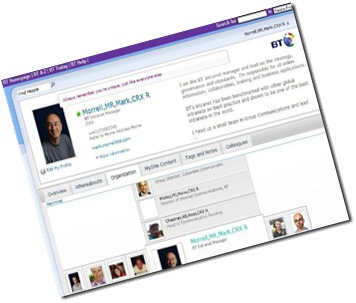
   My second interview in a series of conversations leading up to the Social Workplace Conference on 1st November has been with Mark Morrell, Intranet Pioneer, and previously intranet manager at BT.

Mark talks about his experience at BT and since, working independently.  I think he offers some useful tips, so do view the video, and come along to see more at the conference next month!


Also see #SWConf interview with David Christopher / Oracle and StopThinkSocial


  • Consulting  - Research - Speaking  -  Training -  Writing
  • Strategy   -  Team development  -  Web 2.0  -  Change
  • Contact  me to  create  more  value  for  your  business
  • jon [dot] ingham [at] social [dash] advantage [dot] com

.